The Philosophy of Polymath Data Systems
About Us Polymath Data Systems: We operate on a singular premise the modern enterprise does not suffer from a scarcity of data, but from the engineering friction of disconnected systems.
As technology landscapes undergo a generational shift away from siloed software applications toward real-time, distributed computing fabrics, the roles of the data architect, systems designer, and analytics director have fundamentally merged. Navigating this reality demands a polymathic engineering ethos—one that seamlessly unifies deep software development discipline, low-latency data pipeline mechanics, cloud performance optimization, and scalable semantic modeling.
We are a vendor-neutral, independent technical publication, research platform, and knowledge engine. Our core objective is to deliver deep-dive architectural analysis, pragmatic systems evaluation, and battle-tested engineering methodologies to technical practitioners building the next generation of data-driven enterprise infrastructure.
Defining Our Identity and System Boundaries
To build trust within the enterprise technology space, absolute operational transparency is non-negotiable. It is critical to define exactly who we are, what we focus on, and the clear structural boundaries of our platform identity.
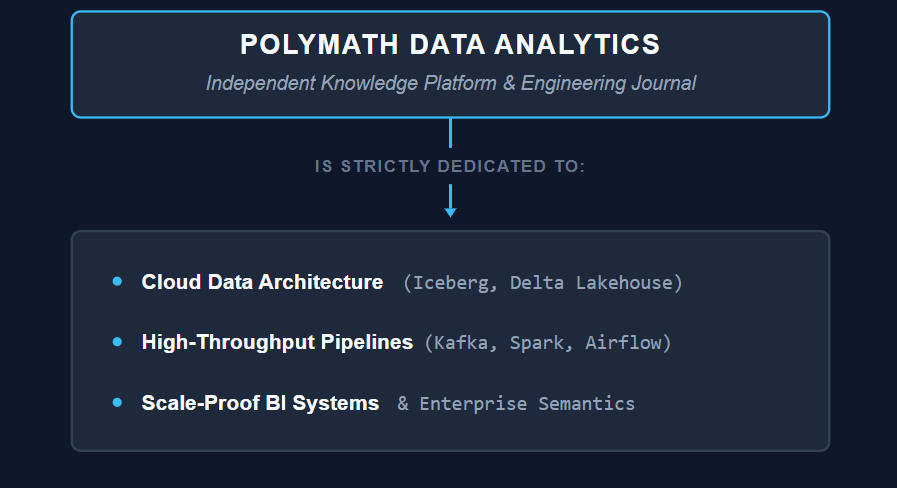
Notice of Platform Origin and Scope: Polymath Data Analytics functions exclusively as an independent, content-driven knowledge platform. We do not manufacture, distribute, or license localized desktop software utilities, monolithic numerical calculation packages, or legacy commercial executables. We maintain zero corporate continuity, shared assets, or operational ties with any prior software vendor or past technical entity that historically utilized this domain space.
By repurposing this platform entirely for cloud-native enterprise analytics and data systems architecture, we bridge classical computational engineering principles with the distributed computing scale of today. We do not host legacy installer packages, software activation registries, or old database backups from previous operators. Our focus is entirely forward-looking, dedicated exclusively to the architecture of the modern data stack.
What We Explore: Our Seven Pillars of Analysis
We do not publish superficial, introductory articles on basic tool configurations. Our editorial direction is rigidly mapped across seven core pillars of enterprise system design:
- Legacy Continuity & Systems Evolution: Analyzing how monolithic software designs, localized computational environments, and early transactional databases mature into modern cloud infrastructure.
- Enterprise Data Architecture: Dissecting storage topologies, multi-cloud data lakes, and open table formats like Apache Iceberg, Delta Lake, and Hudi.
- Data Engineering & Pipeline Fabrics: Breaking down high-throughput, fault-tolerant ingestion pipelines, stateful streaming (Kafka, Flink), and programmatic DAG orchestration (Airflow, Dagster).
- Business Intelligence & Large-Scale Semantics: Exploring the mechanics of centralized metrics layers, semantic definitions, and query optimization to handle massive concurrent dashboard request volumes.
- Cloud Data Platforms & FinOps: Delivering objective, non-promotional inner-workings analyses of major cloud data warehouses alongside cloud spend optimization tactics.
- Data Governance, Lineage, and Security: Engineering deterministic access controls (RBAC/ABAC), automated PII detection, and unalterable end-to-end data lineage mapping for international regulatory compliance.
- Applied Analytics & Production MLOps: Isolating the stable pipeline infrastructure, feature stores, and automated execution loops required to serve real-time predictive models without data drift.
Built for Practitioners, by Practitioners
The modern tech media space is saturated with venture-backed SaaS marketing, superficial artificial intelligence hype, and low-quality affiliate link aggregations. Polymath Data Systems stands resolutely against this dilution of technical content.
Our editorial ecosystem is explicitly designed to act like an engineering graph model rather than a flat chronological blog feed. Every deep-dive we produce links structurally upward to an authoritative core architectural hub, establishing a highly integrated repository of enterprise systems intelligence.
We write for Senior Data Engineers, Principal Architects, CTOs, and tech leaders who require structural breakdowns, memory optimization strategies, and system failure analyses to prevent catastrophic technical debt.
About Us Polymath Data Systems – Our Peer-Review and Guest Submission Framework
Because we prioritize domain expertise over generic search engine copywriting, we welcome highly technical, vendor-neutral contributions from the global data engineering community. We regularly collaborate with:
- Developer Advocates looking to explain complex, open-source infrastructure concepts.
- Systems Architects presenting anonymized case studies of major infrastructure migrations or pipeline refactors.
- Tech Leads detailing concrete strategies for resolving performance bottlenecks or slashing runaway cloud computing bills.
Every external pitch goes through a rigorous, internal peer-review process conducted by our editorial board to ensure that every article published contains verifiable architectural depth.
If you are interested in joining our community of contributors, reading our extensive editorial guidelines, or pitching a technical deep-dive, please visit our [Write for Us] portal or contact us directly through our [Contact Page].
© 2026 Polymath Data Systems. All rights reserved. This platform operates strictly as an independent research, analysis, and tech publication network focused on enterprise-tier data systems architecture.